
The Map & structure
Your book's memory, and its shape
The Map remembers who's who and what's true across a whole manuscript; structure keeps its parts and chapters in order. Both tend your book so you can hold the story instead of the bookkeeping — and neither ever writes a word of your prose.
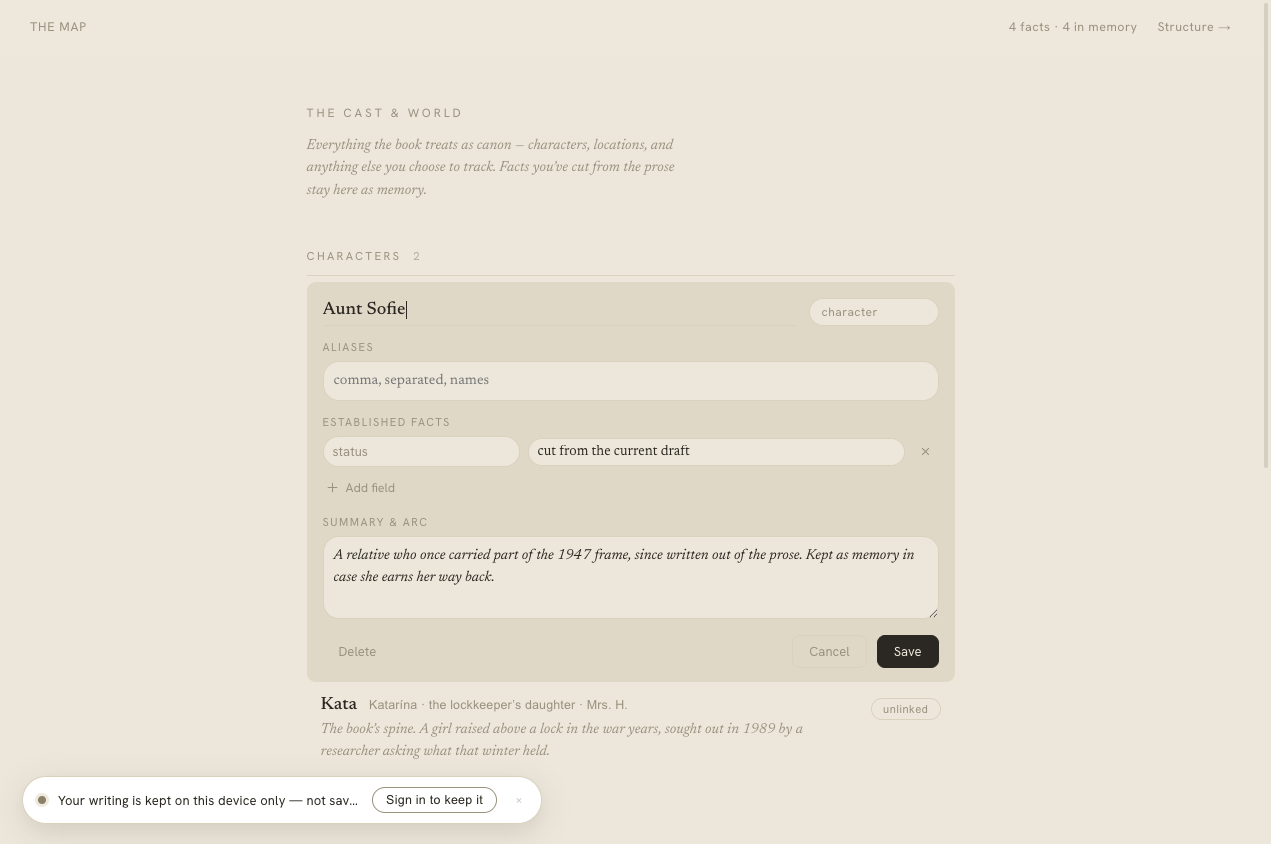
The Map
Everyone and everything, remembered
The Map is your book's memory. Each fact — a character, a place — carries its aliases, its attributes, every mention across your chapters, and its memory states: what's true when, so a detail from chapter two doesn't contradict chapter twenty.
Ask who knew what, or where a name last appeared, and the answer is grounded in the real draft. The Map docs walk through it in full.
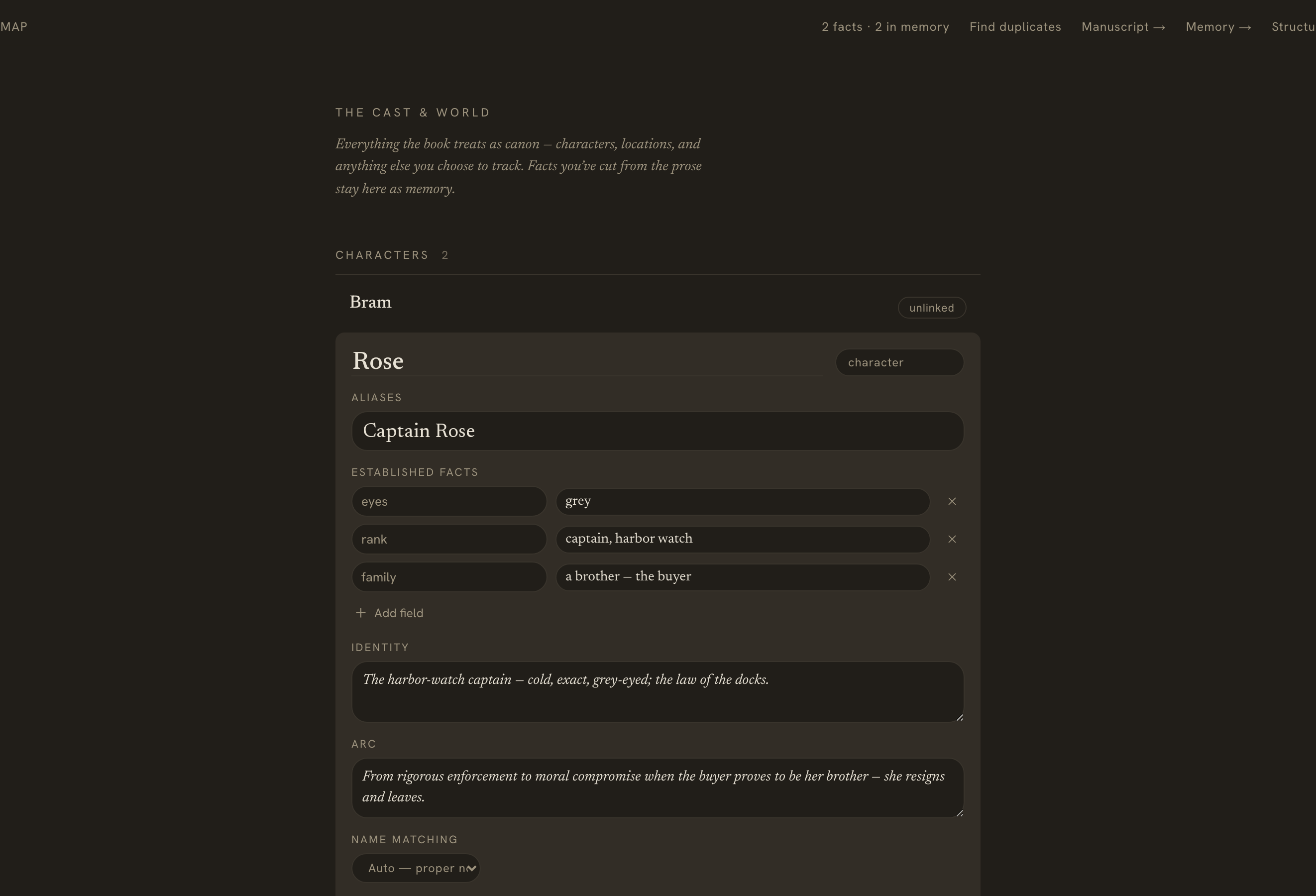
Fact profiles
An identity, an arc, drafted for you
Every fact gets a proper profile: an identity — what it is, stable across the book — and an arc — how it changes — over the established facts the consistency check leans on. A ✦ Draft with AI button fills a blank one from the passages where it appears.
And Profile the cast drafts every blank entry in a single read of the manuscript. See the Map docs.
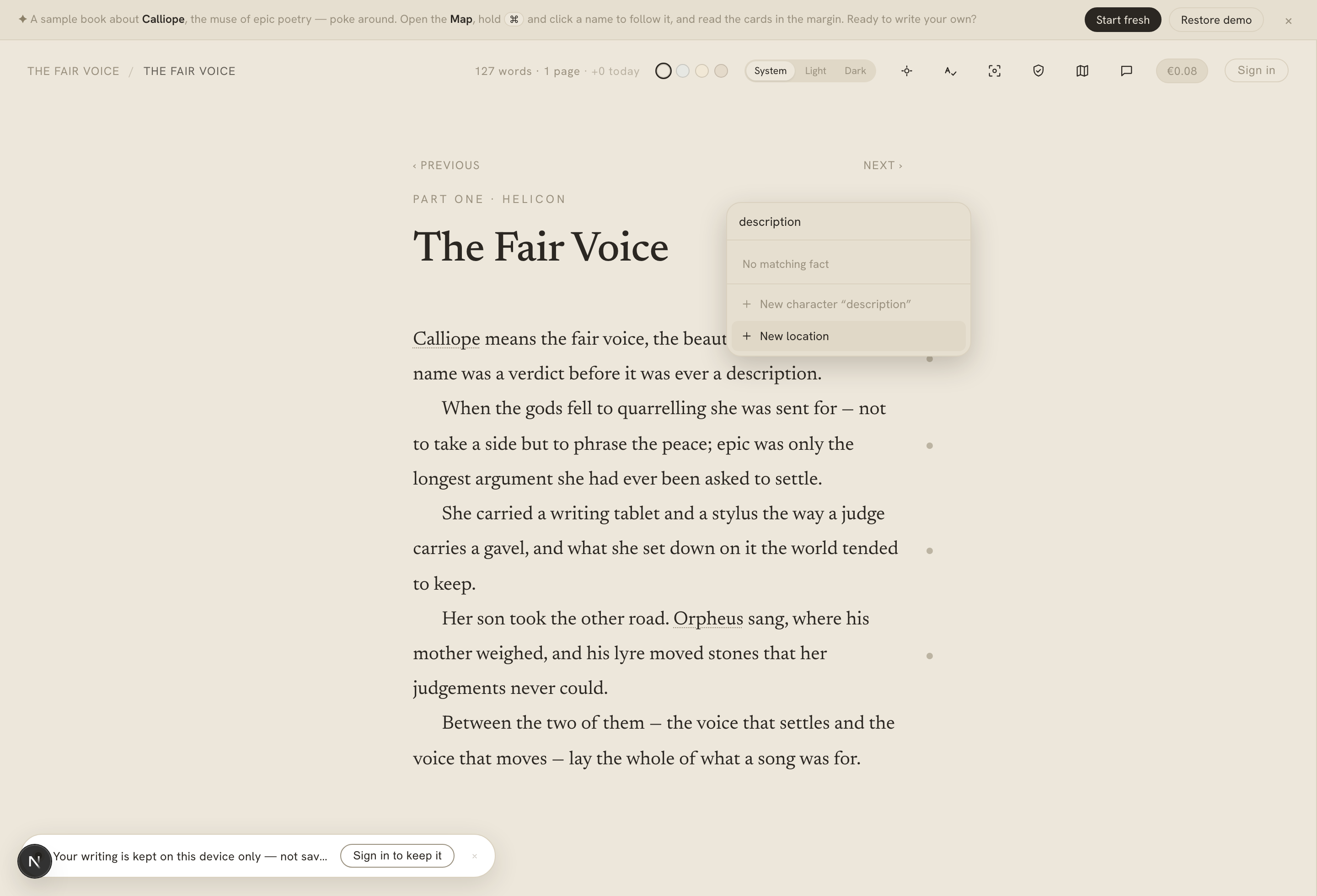
Recognition
It notices the names as you write
As you type, Calliope recognises names already in your Map and quietly links them to their fact. Entity detection goes a step further: when a new character or place shows up, it proposes adding it — it only ever proposes, never decides for you.
And when the same person has crept in twice, find-duplicates spots the pair so you can merge them into one fact — aliases, mentions, and all.
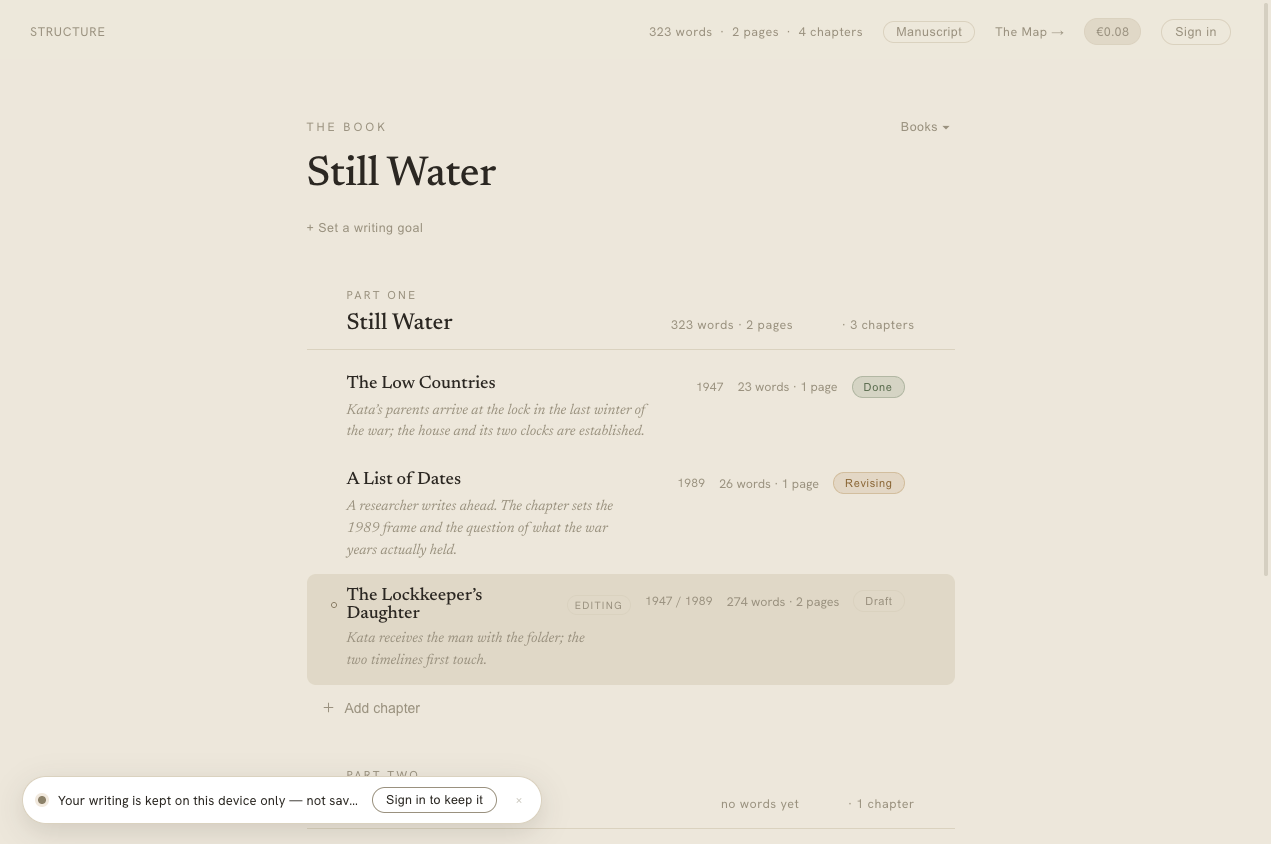
Structure
The shape of the whole book
Structure holds your book's skeleton — parts and chapters you can quick-add, reorder by dragging, and tag with a status so you can see at a glance what's drafted, what's revising, what's done. It's the outline and the table of contents in one, always current.
Each chapter carries a synopsis, with a stale marker when the prose has moved on. See the structure docs for the details.
Explore the rest of Calliope
All features →Write
Distraction-free editing
Real book typography, warm paper themes, dark mode, focus mode, and typewriter scroll — a surface built to disappear so the page is the only thing you see.
Revise
Craft lenses
Ten colour washes that reveal your own habits on the page — adverbs, filter words, sentence rhythm, sensory balance, echoes and more — each teaching from both sides so you decide. It recolours your prose; it never rewrites it.
Feel
Ambience
An opt-in, reactive backdrop for the page — a constellation that grows as you finish sentences, an aurora that deepens as you write. Subtle, peripheral, and off unless you want it.
Reflect
Writing stats
Your habit and your book, given back as a calm stats page — a year heatmap, a forgiving streak, your writing persona, the cast of your story, and a shareable Writing Wrapped. It never shames a slow week.
Think
Marginalia & the AI companion
Notes, to-dos, and chat pinned to the paragraph they're about — beside an AI that reads your whole book, checks it against your canon, and never writes a line of it.
Research
Research beside the page
Ask a question mid-sentence and the companion searches the web, reads the sources, and answers with citations — right in the margin, without pulling you out of the draft. It hands you facts, never prose.
Connect
The MCP connector
Point Claude, ChatGPT, or Cursor at your real book — with a public catalog of editor, critique, character, and craft-drill skills. It reads everything; it never writes your prose.
Automate
The Writer API
Your book as data you can script against — import a legacy manuscript, run a transform, wire a publish pipeline. The one surface where your own prose can flow in and out.
Tends your canon, never your prose
Let the bookkeeping keep itself
The Map and structure carry the memory and the shape of your book so your attention can stay on the story. Everything they do lands in the canon, beside your writing — never in the writing. The pen stays yours.
Start writing — free