
Marginalia & the AI companion
Help beside the page, never on it
Pin notes, to-dos, and references to the exact paragraph they belong to, and talk to a companion that has actually read your book. It reads your chapters, finds mentions, checks your canon, and quotes real text — and it never writes a sentence of your prose.
Marginalia
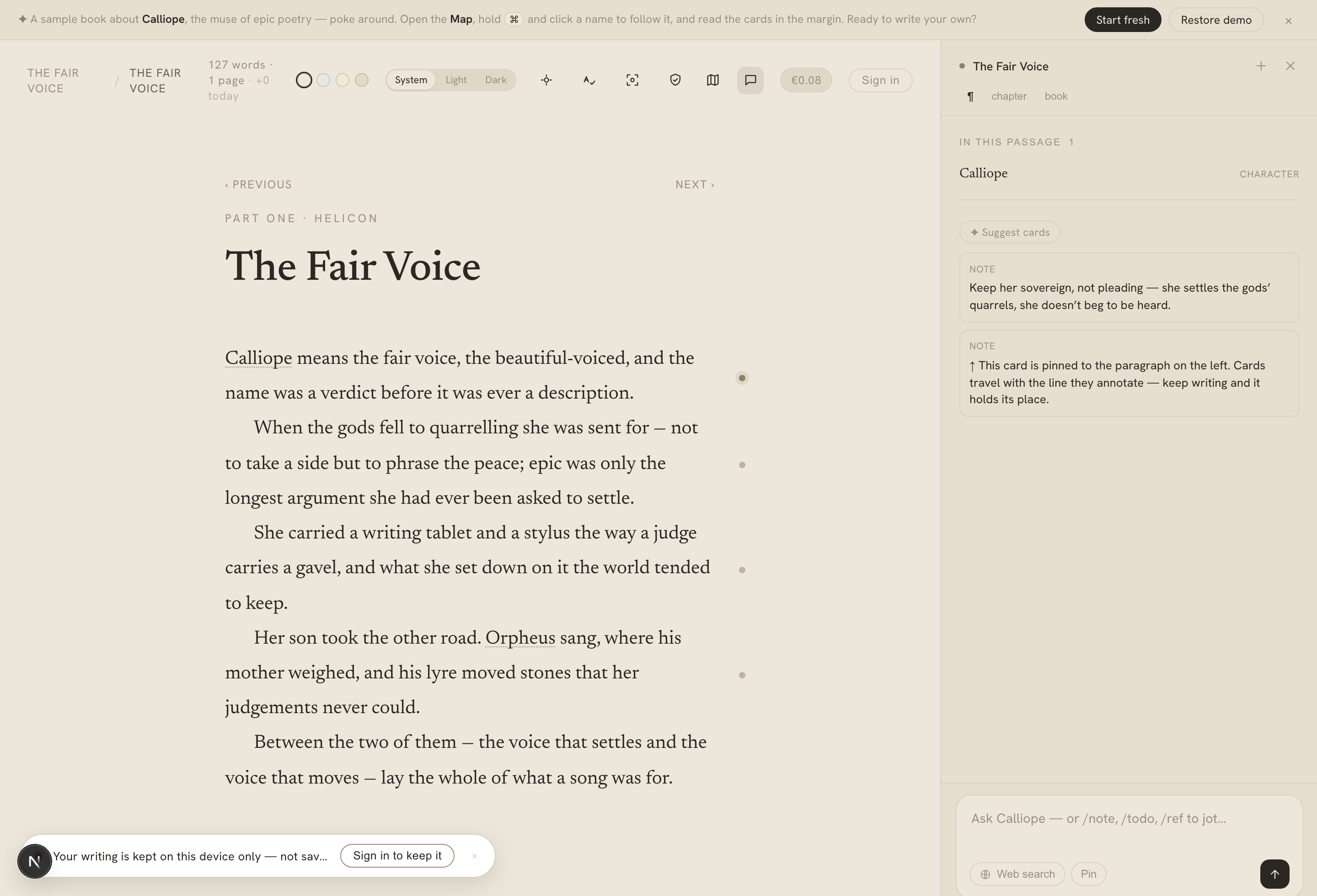
Notes that stay with the sentence
Every thought lands where it matters. A note, a to-do, a reference — each one pins to a paragraph and lives in the margin beside it, not in a separate document you'll forget to open. The prose stays clean; the thinking stays attached.
Come back a week later and the context is exactly where you left it — right next to the line that raised it. See the marginalia docs for how pinning works.
The companion
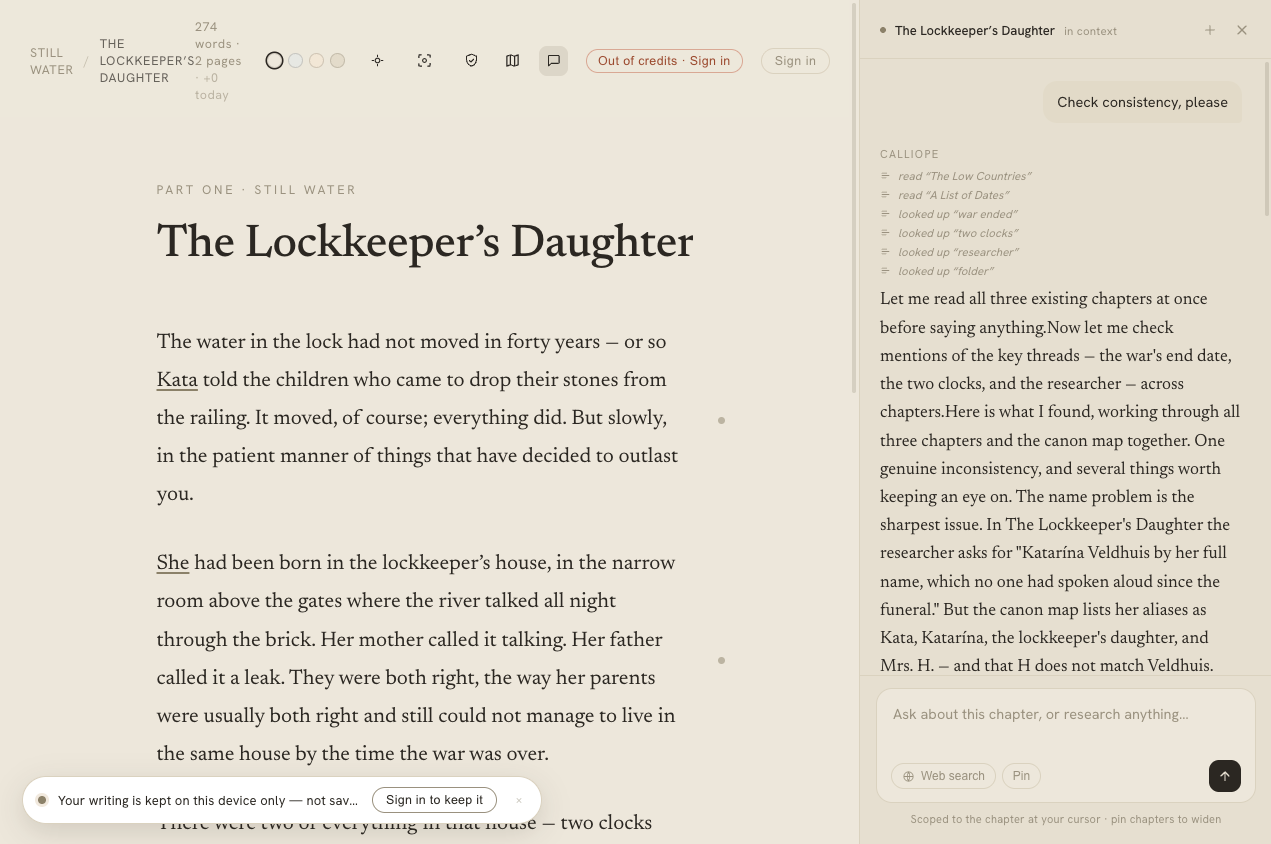
An AI that has read your book
The companion chat isn't a blank assistant working from a paste. It's grounded in your real book — it reads your chapters, finds every mention of a character or place, and answers by quoting your actual text. Ask where you first named the inn, or whether a thread ever paid off, and it looks.
It knows your Map too, so a question about your canon is answered against your canon.
Consistency
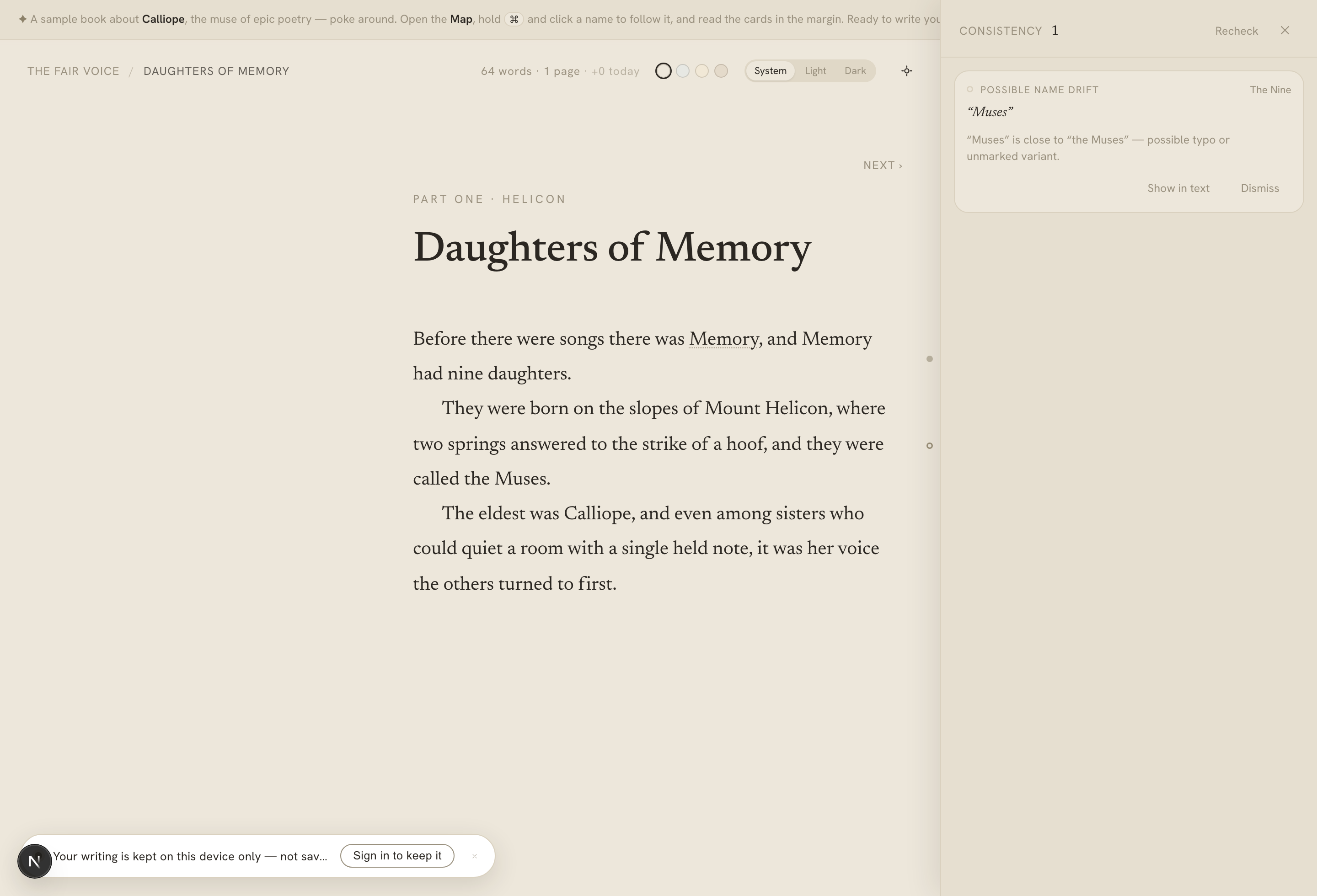
It watches your canon, and nudges
Ask for a consistency check and the companion reads your draft against your canon — the eye colour that drifted, the timeline that slipped, the name that got spelled two ways — and shows you where. When something looks off as you work, it can nudge rather than wait to be asked.
Every result lands beside your prose, in the margin or the Map. Never in the prose itself.
Book memory
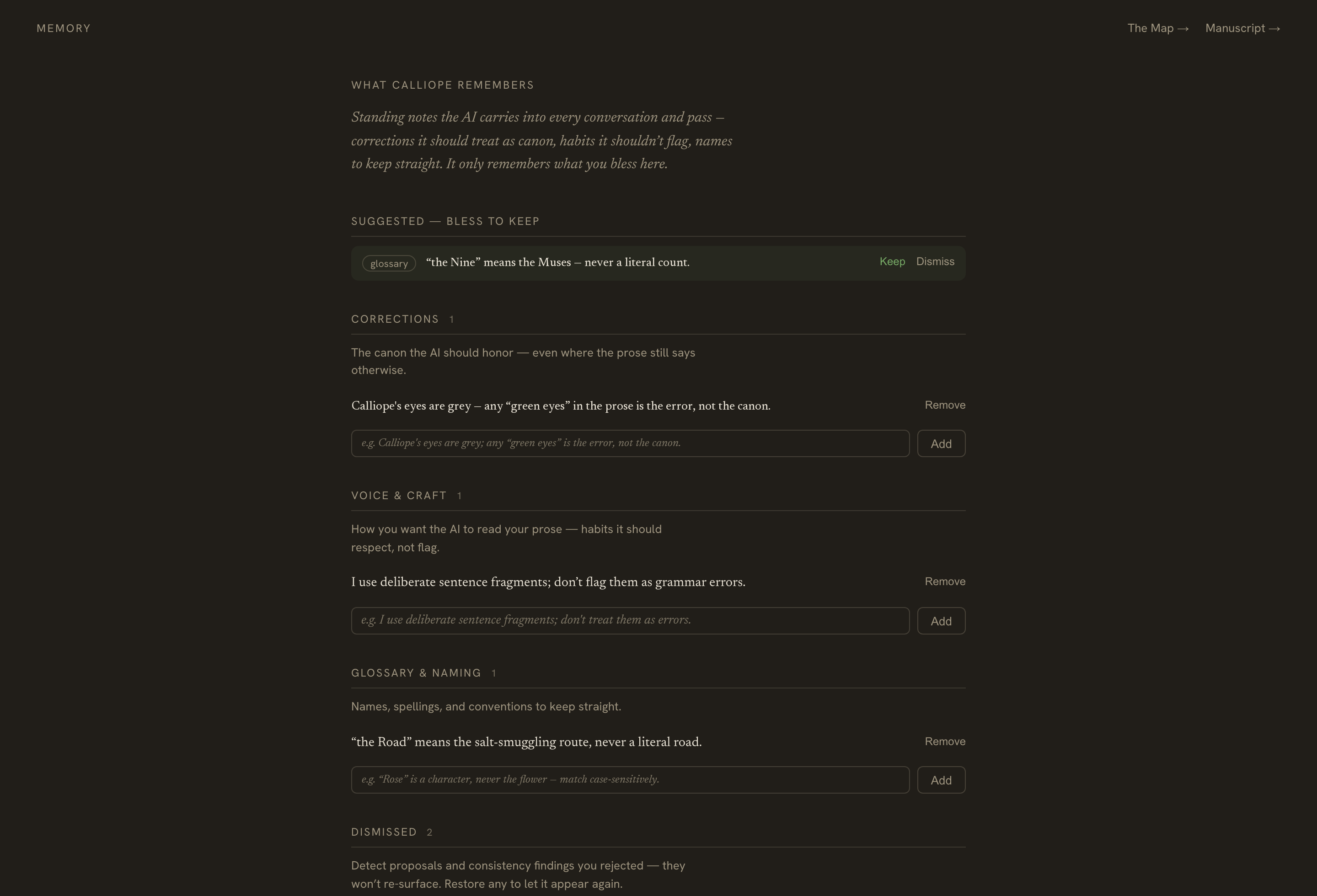
It remembers your book between sessions
Correct something once — "her eyes are grey," "these fragments are deliberate" — and Calliope keeps it. Book memory is a short set of standing notes it carries into every conversation and pass, so it stops re-flagging what you've already settled.
It only remembers what you bless, and anything you dismiss stops coming back. The same memory rides along to your connected tools — more in the docs.
Explore the rest of Calliope
All features →Write
Distraction-free editing
Real book typography, warm paper themes, dark mode, focus mode, and typewriter scroll — a surface built to disappear so the page is the only thing you see.
Revise
Craft lenses
Ten colour washes that reveal your own habits on the page — adverbs, filter words, sentence rhythm, sensory balance, echoes and more — each teaching from both sides so you decide. It recolours your prose; it never rewrites it.
Feel
Ambience
An opt-in, reactive backdrop for the page — a constellation that grows as you finish sentences, an aurora that deepens as you write. Subtle, peripheral, and off unless you want it.
Reflect
Writing stats
Your habit and your book, given back as a calm stats page — a year heatmap, a forgiving streak, your writing persona, the cast of your story, and a shareable Writing Wrapped. It never shames a slow week.
Remember
The Map & structure
The canon of your world — characters, places, facts, every mention — and the outline of your manuscript: parts, chapters, synopses, statuses, reordering.
Research
Research beside the page
Ask a question mid-sentence and the companion searches the web, reads the sources, and answers with citations — right in the margin, without pulling you out of the draft. It hands you facts, never prose.
Connect
The MCP connector
Point Claude, ChatGPT, or Cursor at your real book — with a public catalog of editor, critique, character, and craft-drill skills. It reads everything; it never writes your prose.
Automate
The Writer API
Your book as data you can script against — import a legacy manuscript, run a transform, wire a publish pipeline. The one surface where your own prose can flow in and out.
The one thing it can never do
Write your prose
The companion reads, finds, checks, and organises — but it never returns a sentence for your chapter. It's the most useful reader you've ever had, and it will never be the writer. The pen stays yours.
Start writing — free